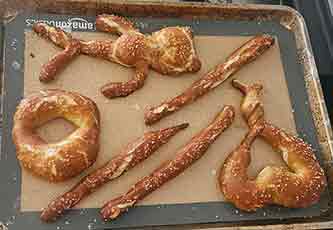
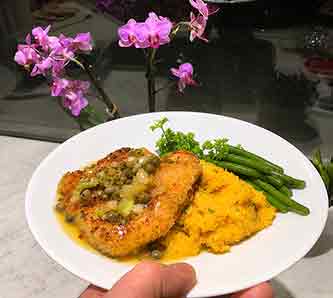
Ok this is not a pretzel but I got a request for the recipe,
and it is one of my families favorites and so simple.
Pretzels
So Many Twists Over Time
A Little Magic and Legend in Every Bite
The pretzel's familiar shape has taken on many meanings over the centuries. One tradition connects its three openings with the Holy Trinity, making it a fitting food for Christian observances, particularly during Lent.
But there was a more mysterious side to the pretzel, too.
A 1928 newspaper article I found described old German superstitions surrounding the Kümmelbrezel, or caraway pretzel. According to the article, caraway was believed to drive away demons, while salt was thought to repel witches and the devil. In some parts of Germany, salt pretzels were even eaten on Ascension Day as protection against fever.
Imagine that! A little caraway, a sprinkle of salt, and perhaps a bit of protection from the supernatural thrown in for good measure.
Of course, these are beliefs reported in an old newspaper, not proof that everyone in medieval Germany shared them. But they offer a fascinating glimpse into a time when food, faith, folk medicine, and superstition often overlapped.
1-The Legend of the Pretzel's Origin
The Baker, the Count, and the Curious Cat
The Swabian legend of how the Brezel was born
Imagine a small German town centuries ago. The baker's oven is warm, flour dusts the workbench, and somewhere nearby, a very important count is in a very bad mood.
At least, that's how one version of the story begins!
A baker's life hangs in the balance
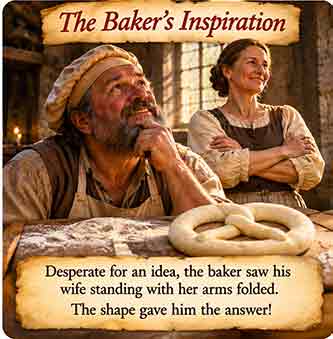
According to a Swabian legend, a baker named Frieder
had fallen into trouble with his ruler.
The count sentenced him to death—but offered him one last chance to save his life.
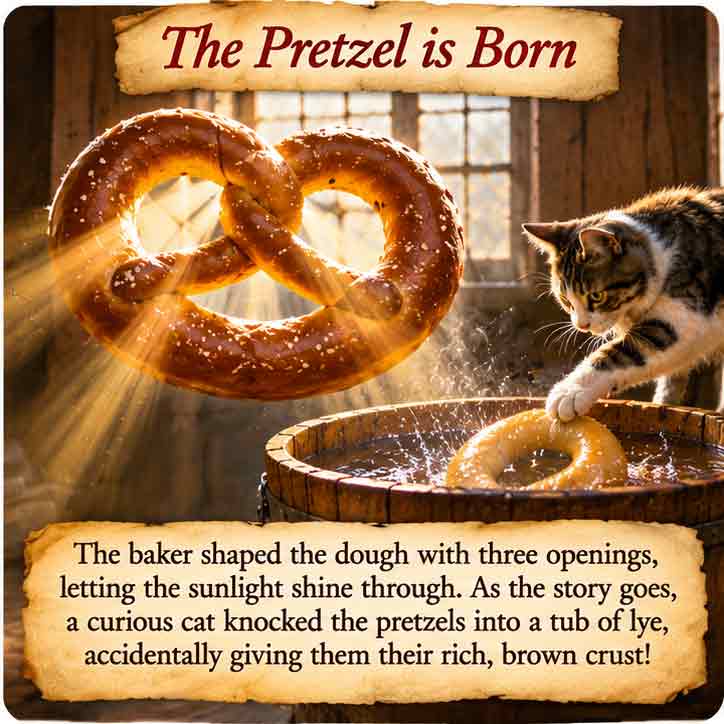
Frieder had to invent a pastry through which the sun could shine three times.
He had three days to come up with something extraordinary. No pressure, right?
Inspiration strikes at home
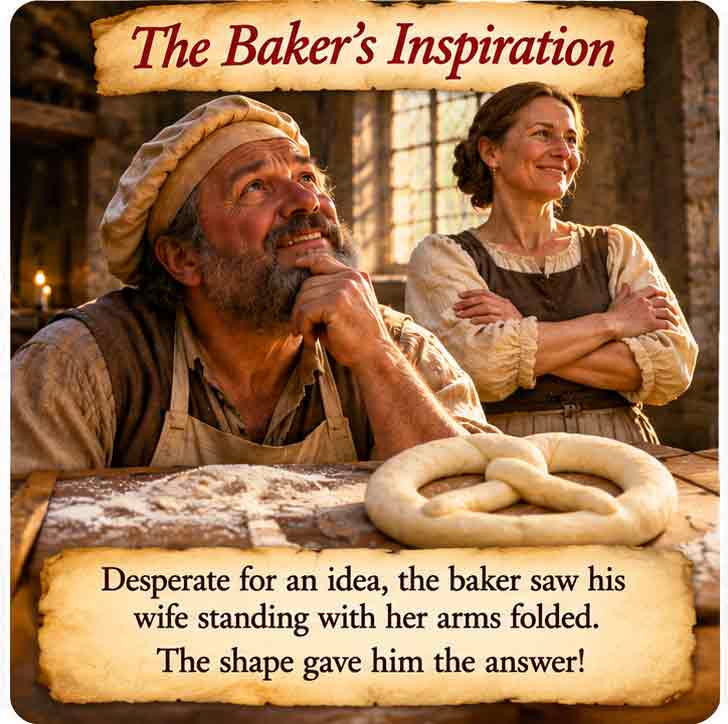
The deadline approached, and Frieder still had no brilliant idea. Then he saw his wife standing nearby with her arms folded across her chest.
Suddenly, inspiration struck!
What if he shaped a rope of dough to resemble her crossed arms? He twisted the ends, formed three openings, and created a pastry unlike any other.
The Brezel was born—or so the legend tells us.
Three holes and three rays of sunshine
When the baker presented his creation, the sunlight shone through its three openings. He had met the count's challenge, and his life was spared.
Look at a traditional pretzel today and you can still see the clever design: two arms crossing in the middle, with three openings framed by the familiar twisted shape.
It is a wonderful story of desperation, inspiration, and a baker who found the answer in an ordinary moment at home.
And then there was the cat!
Some versions of the legend add one more twist. Just when you think the story is finished, a curious cat knocks the unbaked pretzels into a tub of lye.
The accidental dip gives the pretzels their distinctive deep-brown crust when baked.
Did it really happen? Almost certainly not in the tidy way the story suggests! The cat is part of the folklore, not verified baking history. But it makes a terrific ending to a tale about one of Germany's most recognizable baked goods.
A little food for thought
Of course, no one knows for certain exactly how the pretzel originated. Stories about monks, bakers, rulers, and accidental discoveries have been passed down in different forms over the centuries.
But perhaps that's part of the charm. The pretzel is more than a twisted piece of dough: it carries centuries of baking tradition, regional pride, and a few wonderfully entertaining stories.
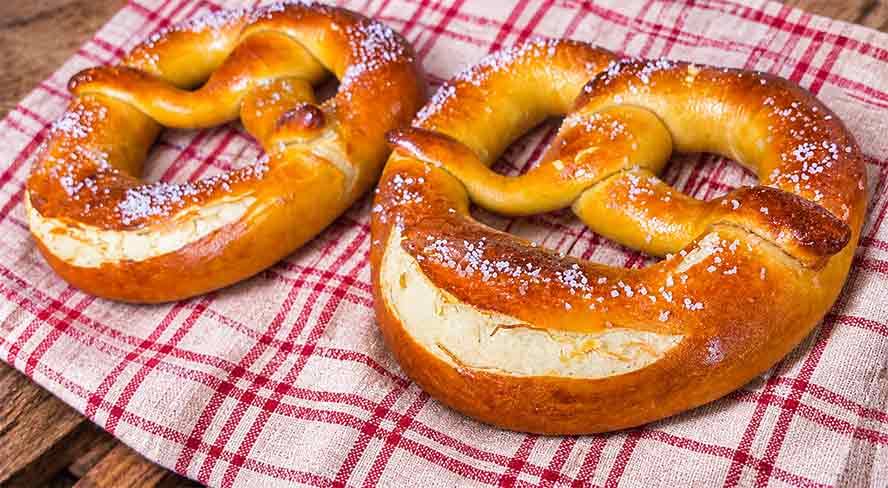
Now it's your turn: Had you heard the legend of the Swabian baker? And tell us—which would you choose: a plump Swabian pretzel with its distinctive belly slash, or a Bavarian pretzel with its thicker arms and naturally split crust?
When the Brezel
become a Pretzel
and a
Crispy Snack
The Mysterious Wandering Baker
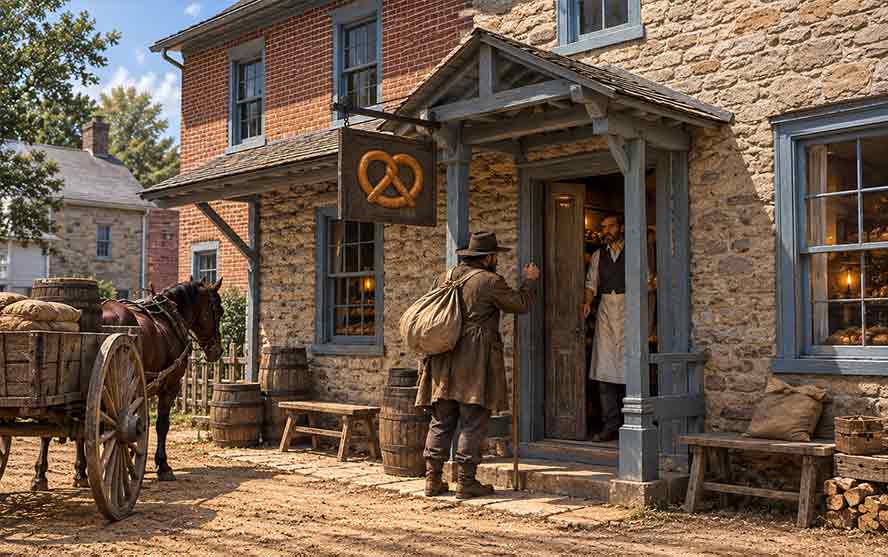
Then we come to one of my favorite parts of the story: the legend of the wandering baker.
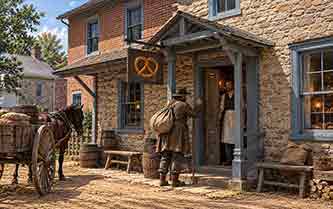
In nineteenth-century Pennsylvania newspaper accounts, a mysterious stranger — sometimes described as a vagrant baker — supposedly wandered into a bakery hungry and in need of help. In exchange for food, he shared the secret of making a pretzel that would stay fresh and crisp, almost like a cracker.
Was there really such a traveler? Did he pass along a new baking technique? Or did the story grow more colorful with every retelling?
We may never know. But the fact that versions of this tale appeared in newspapers so long ago tells us that people were already trying to explain how the hard pretzel came to be.
Other legends are even more dramatic. Some tell of a baker who created a three-holed pastry to save his life; others describe a baker accidentally using lye instead of sugar. These stories vary, and the details are difficult to verify. Still, they make the pretzel's past a lot more entertaining than a simple list of ingredients!
When German-speaking immigrants brought their baking traditions to America, the pretzel found a new home in Pennsylvania. And eventually, it acquired a distinctly American twist.
Julius Sturgis and the Crunchy Revolution
Today, visitors can step into the historic Julius Sturgis Pretzel Bakery in Lititz, Pennsylvania, and learn the story of America's early commercial pretzel industry.
According to the bakery's tour, Julius Sturgis was an apprentice when he noticed that some pretzels had been left in the oven overnight. Those old brick ovens took a long time to cool, and the residual heat gradually dried the forgotten pretzels until they became hard and cracker-like.
Instead of throwing them away, Julius supposedly tasted them and recognized their potential. They were crunchy, they tasted good, and they could be stored for longer than soft pretzels. Perhaps they could even be shipped farther afield and sold as a convenient nibble alongside a drink.
It's a wonderful story. While we can't independently confirm every detail of the overnight discovery, I found something even more interesting in an 1897 newspaper obituary about Sturgis.
The article credited him with a theory: if the pretzel were made much smaller — roughly one-fifth the size of the traditional German product — it might become far more popular. The obituary specifically mentioned people who wanted a little something to eat with their drinks, as well as picnickers and children.
Now that's an interesting bit of business thinking! It suggests that Sturgis wasn't just baking pretzels; he was thinking about his customers and how they might enjoy a new version of a familiar food.
From Bakery to Big Business
The other old newspaper clippings I've found help fill in the bigger picture.
An 1879 article described a pretzel-making machine capable of producing 60 to 100 pretzels per minute. By 1883, another newspaper was discussing the difference between soft pretzels and hard pretzels, including claims that the hard variety could keep for months.
And by 1890, the old Lititz bakery was being promoted as a celebrated establishment selling genuine handmade pretzels.
Put these clues together and a fascinating possibility emerges. A product that was once shaped by hand in local bakeries was becoming a commercial snack. Smaller sizes, longer shelf life, and machinery capable of increasing production all offered ways for pretzels to reach more people.
We shouldn't assume these developments all came from Julius Sturgis, or that every familiar origin story is proven. But the newspaper evidence shows that by the late nineteenth century, pretzel makers were thinking about production, customers, and the business potential of a crunchy little snack.
By 1958, a Pennsylvania newspaper could even tell the story of a pretzel manufacturer using the pretzel as a political symbol while running for governor. The pretzel had become more than a German baked good. It was part of Pennsylvania's identity.
So, What's the Real Story?
Was the hard pretzel born from an overnight baking accident? Did a wandering stranger really share a secret recipe? Did Julius Sturgis recognize an opportunity that other bakers had overlooked?
Some details may remain lost in the past. But the newspaper clippings give us a way to follow the story through time, separating what was reported from what was passed along as legend.
And I think that's part of the fun. Food history isn't always a straight line from one inventor to one recipe. Sometimes it's a trail of old advertisements, newspaper accounts, family stories, and a few clues that don't quite fit together.
One thing is certain: the pretzel has taken plenty of twists over the centuries — from a food associated with faith and superstition to a crunchy snack enjoyed around the world.
American ingenuity struck again, and the pretzel took a new twist!
Now I'm curious: Do you prefer a soft, chewy pretzel or the small, crunchy kind? And had you ever heard the story of the wandering baker?
This recipe gives the basics, although some testing is needed to see how long they
need to cook in the oven. They need to cook quite a while but don't get them too dark.
Also the lower temperature is necessary.
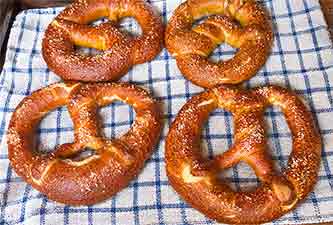
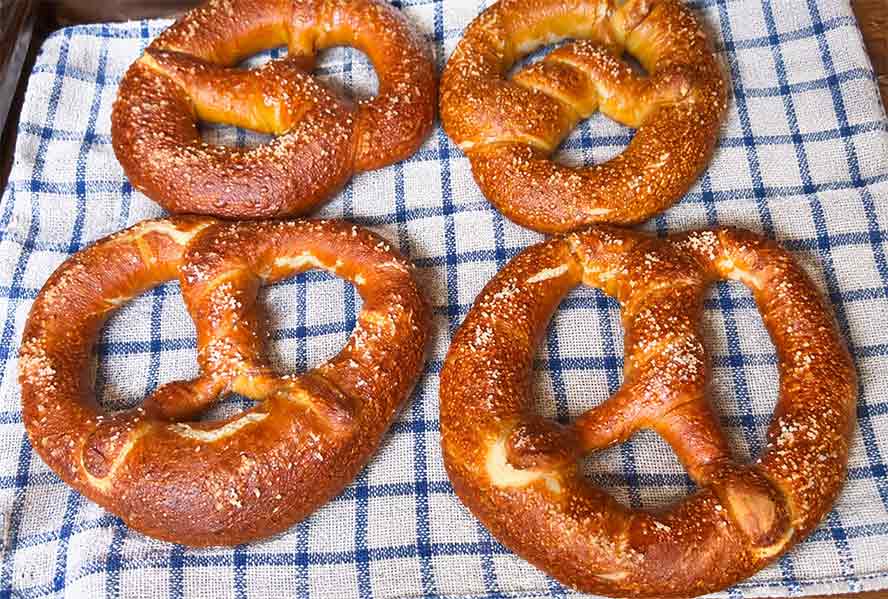
This is my take on the Bavarian style Pretzel
What makes it Bavarian style is that it is baked with a bit bigger arms
than the
Swabian and a natural crust that cracks in places naturally sometimes.
This recipe I made intentionally to be a bit lighter than many of the
Bavarian Pretzel recipes out there. If you do like it a bit more chewy
you can add just a touch more flour, to make it a bit stiffer.
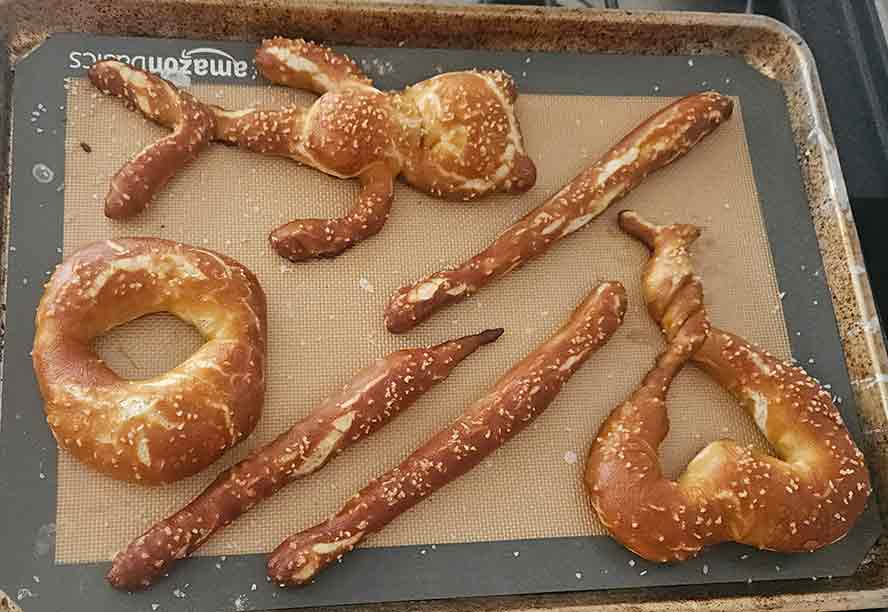
My grandkids really liked this recipe, as it was easy to form their shapes
and the texture was kid friendly.
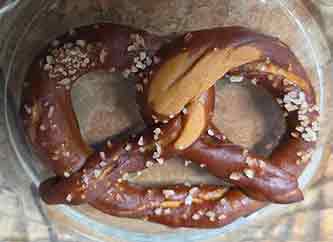
To achieve the beautiful deep mahogany crust
and flavor, I recommend you use Food Grade Lye
If you want pretzels with that beautiful, deep mahogany-brown crust and distinctive flavor, a traditional lye bath is the way to go. Food-grade sodium hydroxide is what gives authentic German Laugenbrezeln their characteristic color, shine, and flavor.
A little goes a long way. Be sure to purchase food-grade sodium hydroxide specifically intended for food use—not drain cleaner or general-purpose lye. Follow your recipe's instructions carefully, and always wear protective gloves and eye protection when preparing and using a lye bath. Add the lye to the water, never the other way around, and use a stainless-steel or suitable food-safe plastic container. Keep it away from children and pets.
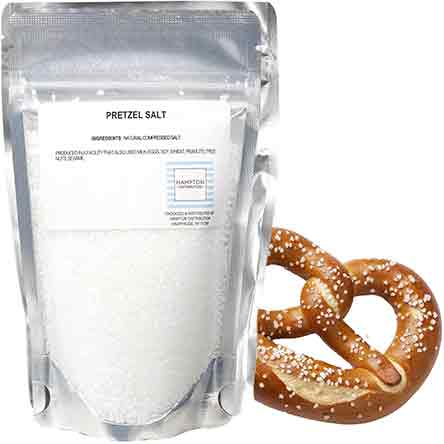
Pretzel salt is designed to not disolve on top of your pretzel as it bakes.
It is more compact so it disolves less easy.
Pretzel salt is a special coarse-grained salt used to finish traditional German pretzels (Laugenbrezeln). Its large, chunky crystals stand out against the dark, glossy crust, adding that familiar salty crunch in every bite.
Unlike ordinary table salt, pretzel salt is designed to hold its shape and remain visible on the pretzel rather than quickly dissolving into the crust. A little goes a long way!
I've been looking at German pretzels for years and years, and for a long time they all seemed pretty much the same to me. Some had a slash down the belly, while others split open in the oven, creating a little ear like the one on an artisan loaf of bread. And then there were the arms — some pretzels had tiny T. rex arms, while others had much thicker ones!
It turns out these little details tell a story.
Think about the great American pizza debate. New York has its thin, foldable slices, while Chicago proudly serves up its deep-dish pies. They're both pizza, but ask a loyal fan and you'll quickly discover that the differences matter!
Germany has its own regional food loyalties. The Swabian pretzel, with its generous belly, skinny arms, and distinctive scored opening, has a character all its own. Its Bavarian cousin follows a different tradition, with thicker arms and a belly that often opens naturally during baking.
So what makes these two pretzels different? And why do regional baking traditions become such a source of pride? Let's take a closer look at the Swabian Brezel,
And learn how to do
Der Schnitt = the cut or slash the baker makes.
Der Ausbund = the characteristic opening that develops as the pretzel bakes.
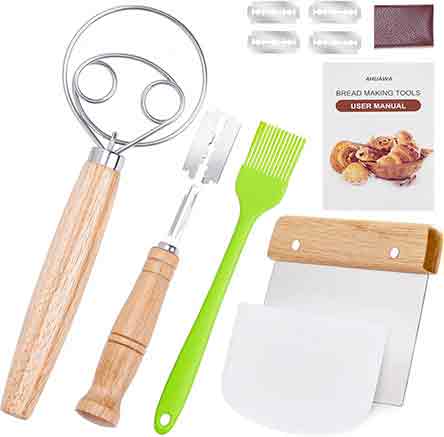
This little kit includes several tools I use regularly in my own kitchen: a Danish dough whisk, bench scraper, bowl scraper, and bread lame.
The bread lame is especially useful when making Swabian-style pretzels. It gives you a sharp blade for making the traditional belly cut (Schnitt), which opens up during baking to create the characteristic Swabian pretzel shape (Ausbund).
The other tools are equally handy for mixing, dividing, shaping, and handling dough. Although sold as a sourdough kit, these are useful tools for all kinds of home baking.
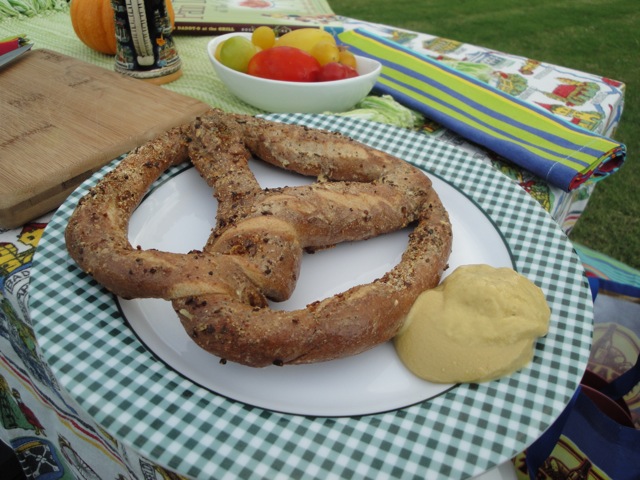
This uses a white whole wheat flour, which is not refined
but a lighter color than regular Whole Wheat.
It has a nice flavor, and this style
uses Baking Soda instead of the Lye (Sodium Hydroxide) bath.
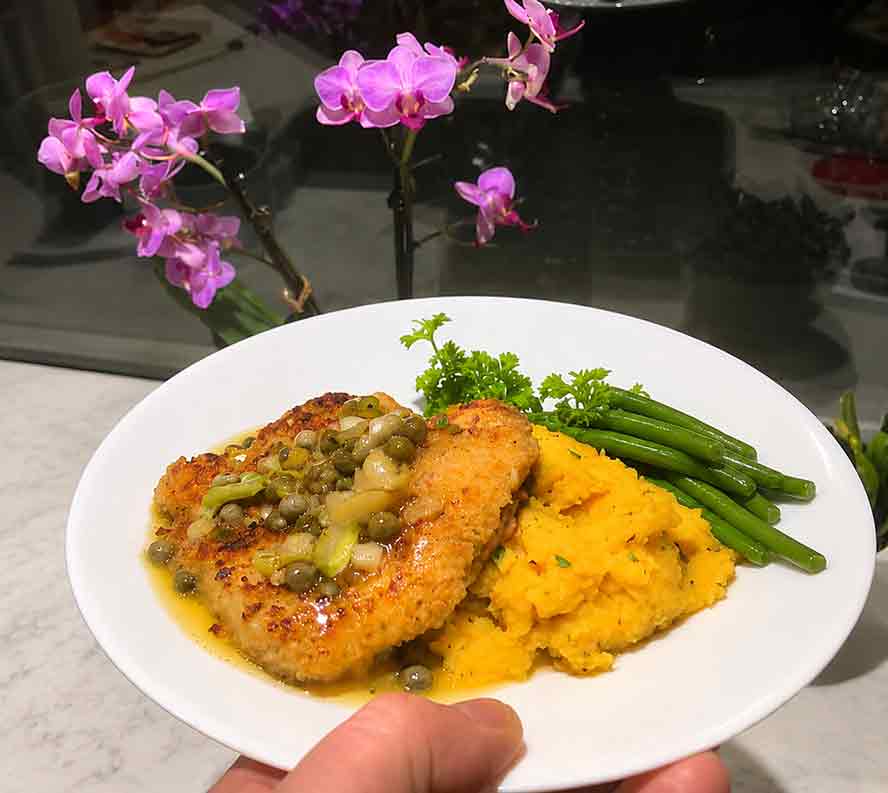
I know this isn't a pretzel dish, but I got a request for the recipe,
so I thought I would include this, as it is one of my favorites,
and if I can't decide what to have for dinner, this is an easy one to prepare.
These 2 tourists are a little corny, but they make a really great video
of what it is like to go through the Julius Sturgis interactive Pretzel Museum.
12 piece , 1,2 and 4 cup
Snapware Total Solution Glass Storage Containers are the kind of practical kitchen containers that somehow become part of every picnic, potluck, and leftovers night.
The glass dishes keep salads, stuffed celery, and picnic foods tasting fresh, while the locking lids travel well in a cooler without leaks or spills. I especially like these for Ausflug-style picnic food because they stack neatly, clean up easily, and look good enough to go straight from the refrigerator to the picnic blanket.
A simple but essential tool for asparagus season, this peeler removes the tough outer layer quickly and evenly, leaving the spears tender and ready for cooking. Especially useful when working with thicker asparagus, it makes a noticeable difference in texture.
Her recipes, culture and cooking styles that were brought over from Germany. How they evolved when she came to America in the early 1900s and settled in Portland, Oregon on the west coast of the United States. Over 100 recipes
Bonus recipes with step by step color pictures
Online for download
Rest your laptop,tablet or phone
in the Kitchen counter
and follow the recipes with pictures to help.
Bonus
PDF
for you to download
Read on your
phone, tablet or laptop
Vintage German Postcard replica's to use as bookmarks or to mail.
From Germany with Love tells the story of my grandma, Emma Block, growing up in a little town in Baden/ Würtemberg, Germany near Heidelberg named Steinsfurt. Then at the age of 15 immigrating to the United States, taking a train with one of her sisters and brothers to Hamburg and sailing the Atlantic with other hope filled Germans wanting to make a life in the "New World". It was not easy but with good values learned in her German upbringing made a full life, had a wonderful family with lots of fun and celebration including the great German meals.
Through modern technology we can enjoy music from Germany at the touch of your computer, there are many venues now, Pandora, Amazon music, and Youtube is free.
I love my noise canceling headphones that are completely wireless and give incredible sound!
over 2500 perfect reviews, it is a bit of an investment but worth every penny.
ROCK Mi
Orchestra Meets German Schlager
This Clip: Maestro Guido invited his friends of @voXXclub. This vocal group is a household name in Germany, Austria, and Switzerland. They perform worldwide more than 100 shows a year and many TV appearances. Next to the fact that they are great singers, they became also good friends with Guido and Wendy. For this concert he Maestro made a new arrangement of this vibrant German song.
A German Summer-ey Song
Goldried Quintett -
Mei Muata und mei Vota
Volksmusik Video Kunterbunter Streifzug durch die
Volksmusik Bekannte Interpreten der Letzten Ja
Folk Music Video: A Colorful Journey Through Folk Music -
Famous Performers of the Last Year
Volkstümliche Schlager Hitmix Bekannte Interpreten der Letzten Jahre
Popular Schlager Hitmix - Famous Artists of Recent Years
Some of my favorite music from the Zillertal Valley
Thisis a great half hour of good fun music for the season